Your organization executes thousands of processes daily. Order fulfillment, customer onboarding, invoice processing, employee training - each follows specific steps, involves multiple people, and impacts your bottom line. Yet most companies manage these critical workflows through email chains, spreadsheets, and memory.
That's where Business Process Management comes in.
Business Process Management (BPM) is the discipline of discovering, designing, executing, monitoring, and optimizing organizational processes to achieve strategic goals. It transforms chaotic, ad-hoc work into systematic, measurable, and continuously improving operations.
But here's what most BPM guides won't tell you: implementing BPM isn't just about technology or methodology. It's about fundamentally changing how your organization thinks about work.
The evolution of business process management
BPM didn't emerge overnight. Its roots trace back to the early 20th century with Frederick Taylor's scientific management principles. The journey from time-and-motion studies to today's AI-powered process optimization tells us something important: businesses have always sought better ways to organize work.
The 1990s brought Business Process Reengineering (BPR), promising radical redesigns and dramatic improvements. Many failed spectacularly. Why? They ignored the human element.
The 2000s introduced workflow automation and BPMS (Business Process Management Systems). Technology finally caught up with ambition. But organizations learned another hard lesson: software alone doesn't fix broken processes.
Today's BPM combines the best of these approaches with modern innovations:
- Process mining discovers how work actually happens (not how we think it happens)
- AI predicts bottlenecks before they occur
- Low-code platforms democratize process improvement
- Cloud infrastructure enables instant scalability
Understanding the three types of BPM
Not all processes are created equal. Understanding which type of BPM fits your needs determines success or failure.
1. Integration-centric BPM
This focuses on processes with minimal human involvement. Think data synchronization between your CRM and accounting system, or automated inventory reordering based on stock levels.
Best for: High-volume, rule-based processes where systems talk to systems.
Example: A bank processing 100,000 daily transactions between core banking systems and regulatory reporting platforms.
Key consideration: Requires robust API architecture and error handling mechanisms.
2. Human-centric BPM
The majority of business processes fall here. These involve human decisions, approvals, and interactions that can't be fully automated.
Best for: Processes requiring judgment, creativity, or exception handling.
Example: Insurance claim processing where adjusters evaluate damage, negotiate settlements, and handle escalations.
Key consideration: User experience determines adoption. Complex interfaces kill even the best-designed processes.
3. Document-centric BPM
These processes revolve around creating, reviewing, approving, and distributing documents. Contract management, regulatory filings, and policy creation live here.
Best for: Compliance-heavy industries where document integrity and audit trails are critical.
Example: FDA submission process for pharmaceutical companies, involving thousands of pages across multiple departments.
Key consideration: Version control and access management become paramount.
The BPM lifecycle: How continuous improvement actually works
The BPM lifecycle isn't linear - it's a continuous loop. Each iteration reveals new optimization opportunities. Here's how it works in practice:
Phase 1: Discovery and design
Before improving a process, you need to understand it. This phase uncovers the current state (as-is) and designs the future state (to-be).
Discovery techniques:
- Process mining: Software analyzes system logs to reveal actual process flows. One healthcare organization discovered their "5-step" patient discharge actually involved 47 steps across 6 departments.
- Observation: Watch people work. You'll spot workarounds, shortcuts, and pain points no interview reveals.
- Workshop mapping: Bring stakeholders together to map processes collaboratively. The debates alone surface valuable insights.
Design principles:
- Start with customer value - what outcome matters most?
- Eliminate non-value-adding steps ruthlessly
- Build in flexibility for common exceptions
- Design for the 80%, handle the 20% separately
Phase 2: Modeling
This transforms your design into a visual, analyzable format. BPMN (Business Process Model and Notation) has become the de facto standard, but don't get lost in notation wars.
What makes a good model:
- Clarity over completeness - capture the essence, not every detail
- Swim lanes showing clear ownership
- Decision points with defined criteria
- Time estimates for bottleneck identification
- Integration points with other processes
Common modeling mistakes:
- Over-engineering for rare exceptions
- Ignoring informal communication channels
- Assuming technology capabilities that don't exist
- Creating models nobody will maintain
Phase 3: Execution
This is where theory meets reality. Execution involves configuring systems, training people, and launching the new process.
Successful execution requires:
- Pilot approach: Test with a small group before full rollout. A logistics company tested their new returns process with one product line, refined it based on feedback, then expanded.
- Change management: People resist new processes. Address the "what's in it for me?" question explicitly.
- Fallback plans: Things will go wrong. Have manual workarounds ready.
- Quick wins: Design early victories to build momentum.
Phase 4: Monitoring
Real-time visibility separates modern BPM from traditional approaches. You're tracking both process metrics and business outcomes.
Critical metrics to monitor:
- Cycle time: Total duration from start to finish
- Process efficiency: Value-adding time vs. total time
- First-time-right rate: Percentage completed without rework
- Cost per transaction: Total cost divided by volume
- Customer satisfaction: The ultimate success measure
Advanced monitoring techniques:
- Predictive analytics to forecast bottlenecks
- Anomaly detection for unusual patterns
- Sentiment analysis on process feedback
- Real-time dashboards for different stakeholder views
Phase 5: Optimization
This phase closes the loop, using monitoring insights to drive improvements. The best organizations optimize continuously, not periodically.
Optimization strategies:
- Incremental improvements: Small changes compound. Reducing one approval step saved a retailer 3 days per order.
- Automation opportunities: Replace manual tasks with RPA or AI where appropriate
- Process redesign: Sometimes incremental isn't enough - fundamental redesign needed
- Process elimination: The best process improvement might be deletion
BPM methodologies: Choosing the right approach
Different methodologies suit different situations. Here's when to use each major approach:
Six Sigma: When precision matters
Six Sigma uses statistical analysis to reduce process variation and defects. The DMAIC framework (Define, Measure, Analyze, Improve, Control) provides rigorous structure.
Use Six Sigma when:
- Quality problems cost significant money
- You have data (or can collect it)
- Process variation causes customer issues
- Stakeholders respect data-driven decisions
Real example: A medical device manufacturer used Six Sigma to reduce assembly defects from 3.2% to 0.04%, saving $12 million annually while potentially saving lives.
Limitations: Can be slow, expensive, and overkill for simple problems. Also struggles with creative or highly variable processes.
Lean: When speed and waste reduction matter
Lean focuses on eliminating waste (muda) and creating flow. It identifies seven types of waste: overproduction, waiting, transportation, over-processing, inventory, motion, and defects.
Use Lean when:
- Cycle time reduction is critical
- Inventory or work-in-progress is excessive
- Customer value is clear and measurable
- Quick wins build momentum
Real example: An insurance company applied Lean to claims processing, reducing average settlement time from 15 days to 3 days by eliminating waiting and handoffs.
Limitations: May oversimplify complex processes. Focus on efficiency can compromise effectiveness or employee satisfaction.
Agile BPM: When flexibility matters
Agile BPM applies iterative development principles to process improvement. Instead of big-bang implementations, it delivers incremental improvements quickly.
Use Agile BPM when:
- Requirements are unclear or changing
- Rapid iteration beats perfect planning
- User feedback drives design
- Technology enables quick changes
Real example: A fintech startup used Agile BPM to evolve their customer onboarding process weekly based on user behavior data, improving completion rates from 45% to 78% over three months.
Limitations: Can lack strategic direction. Constant change may confuse users or complicate compliance.
Total Quality Management (TQM): When culture matters
TQM embeds quality thinking throughout the organization. It's less a methodology than a philosophy emphasizing continuous improvement by everyone.
Use TQM when:
- Quality problems are systemic
- Cultural change is necessary
- Long-term thinking prevails
- Employee engagement is high
Real example: Toyota's production system exemplifies TQM, where any worker can stop the production line to fix quality issues, resulting in industry-leading reliability.
Limitations: Requires significant cultural shift. Results take time. Can become bureaucratic if poorly implemented.
Process mining: Discovering reality vs. assumption
Process mining represents a paradigm shift in BPM. Instead of asking people how processes work, software analyzes event logs to show what actually happens.
How process mining works
Every interaction with IT systems creates a digital footprint. Process mining tools reconstruct actual process flows from these traces, revealing:
- All process variants (including ones you didn't know existed)
- Actual cycle times and bottlenecks
- Compliance violations and workarounds
- Rework loops and inefficiencies
Process mining in action
A telecommunications company believed their service activation process had 12 variants. Process mining revealed 4,287 variants. The top 20 variants handled 80% of volume, leading to focused optimization efforts that reduced activation time by 40%.
Combining process mining with other techniques
Process mining works best when combined with:
- RPA (Robotic Process Automation): Mine processes to identify automation candidates
- Machine Learning: Predict process outcomes and recommend next best actions
- Simulation: Test process changes before implementation
- Conformance checking: Ensure processes follow designed paths
Measuring BPM success: ROI and beyond
Organizations investing in BPM report impressive returns, but measurement goes beyond simple ROI calculations.
Quantifiable benefits
Research across industries shows consistent improvements:
- Cycle time reduction: 20-50% average improvement
- Cost reduction: 15-30% through efficiency gains
- Error reduction: 40-60% fewer mistakes and rework
- Productivity increase: 25-40% more output with same resources
- Customer satisfaction: 15-25% improvement in NPS scores
Industry-specific ROI patterns
Different industries see different benefits:
- Manufacturing: 25-40% reduction in production costs through waste elimination
- Healthcare: 30-45% reduction in patient wait times and administrative costs
- Financial Services: 50-70% faster loan processing with improved compliance
- Retail: 20-35% improvement in inventory turnover and order fulfillment
Hidden value creation
Some BPM benefits resist easy quantification but matter enormously:
- Organizational agility: Faster response to market changes
- Knowledge preservation: Processes document institutional knowledge
- Risk reduction: Consistent processes reduce compliance violations
- Employee satisfaction: Clear processes reduce frustration and burnout
- Innovation enablement: Standardized processes free resources for innovation
Calculating your BPM ROI
Use this framework to estimate potential returns:
- Identify current costs:
- Labor hours per process
- Error correction costs
- Customer churn from poor experiences
- Compliance violation penalties
- Estimate improvements:
- Conservative: 15-20% improvement
- Moderate: 25-35% improvement
- Aggressive: 40-50% improvement
- Factor implementation costs:
- Software licensing/subscription
- Consulting or internal resources
- Training and change management
- Temporary productivity dip
- Calculate payback period:
- Typical payback: 6-18 months
- Break-even often within first year
- Full benefits realized by year two
Common BPM implementation challenges (and how to overcome them)
Understanding why BPM initiatives fail helps ensure yours succeeds. Here are the most common pitfalls and proven solutions:
Challenge 1: Resistance to change
People comfortable with current processes resist new approaches. "We've always done it this way" becomes a mantra.
Solutions:
- Involve affected employees in process design
- Communicate benefits in personal terms (less frustration, not just efficiency)
- Create change champions within each department
- Celebrate early adopters publicly
Challenge 2: Lack of executive sponsorship
Without C-suite support, BPM initiatives wither. Middle management won't prioritize what leadership doesn't value.
Solutions:
- Connect BPM to strategic objectives explicitly
- Present in business terms, not process jargon
- Start with a high-visibility, high-impact process
- Regular executive briefings on progress and wins
Challenge 3: Technology-first thinking
Organizations buy expensive BPMS platforms before understanding their processes. The tool becomes the goal, not process improvement.
Solutions:
- Map and improve processes manually first
- Define requirements based on actual needs
- Start with simple tools, evolve to complex ones
- Focus on adoption over features
Challenge 4: Analysis paralysis
Teams spend months perfecting process models that never get implemented. Perfect becomes the enemy of good.
Solutions:
- Set aggressive timelines for first implementation
- Embrace "good enough" for version 1.0
- Plan iterations from the start
- Measure progress, not perfection
Challenge 5: Siloed implementation
Departments optimize their processes without considering upstream or downstream impacts. Local optimization creates global problems.
Solutions:
- Map end-to-end processes crossing departments
- Create cross-functional process owners
- Measure customer outcomes, not departmental metrics
- Regular inter-department process reviews
BPM in the age of digital transformation
Modern BPM looks nothing like its predecessors. Digital technologies have transformed both what's possible and what's expected.
Hyperautomation: Beyond simple RPA
Hyperautomation combines multiple technologies to automate complex processes:
- RPA handles repetitive tasks
- AI/ML makes decisions and predictions
- Process mining identifies automation opportunities
- Low-code platforms enable rapid development
- Integration platforms connect disparate systems
Example: A bank automated 70% of loan processing by combining OCR for document reading, AI for credit decisions, RPA for data entry, and workflow orchestration for routing.
Intelligent Document Processing (IDP)
IDP extracts meaning from unstructured documents using AI. This bridges the gap between paper-based and digital processes.
Applications include:
- Invoice processing without templates
- Contract analysis and risk assessment
- Medical record digitization
- Regulatory filing automation
Process Intelligence
AI doesn't just automate - it provides insights:
- Predict process outcomes before completion
- Recommend next best actions to workers
- Identify anomalies requiring investigation
- Optimize resource allocation dynamically
Cloud-native BPM
Cloud platforms transform BPM economics and capabilities:
- Start small, scale infinitely
- Pay per use, not per license
- Deploy globally in minutes
- Integrate with ecosystem easily
- Update continuously without disruption
Industry-specific BPM applications
While BPM principles remain consistent, implementation varies dramatically by industry. Understanding sector-specific nuances ensures relevant solutions.
Healthcare: Patient flow and regulatory compliance
Healthcare organizations balance patient care with regulatory requirements. Key processes include:
- Patient journey optimization: From admission to discharge, reducing wait times while ensuring quality care
- Revenue cycle management: Insurance verification, coding, billing, and collections
- Regulatory compliance: HIPAA, clinical protocols, and reporting requirements
- Supply chain: Medical supply ordering, inventory, and distribution
Case study: A hospital system reduced emergency room wait times by 40% through process optimization, while improving patient satisfaction scores by 25%.
Financial services: Speed and compliance
Banks and insurance companies must balance customer experience with risk management:
- Know Your Customer (KYC): Onboarding while meeting regulatory requirements
- Loan origination: Application to funding optimization
- Claims processing: Rapid settlement with fraud prevention
- Regulatory reporting: Automated compliance with changing regulations
Case study: A regional bank reduced loan approval time from 7 days to 4 hours using intelligent process automation, while maintaining risk standards.
Manufacturing: Operational excellence
Manufacturers focus on efficiency, quality, and supply chain optimization:
- Order to delivery: Complete fulfillment cycle optimization
- Quality management: Defect prevention and rapid response
- Supply chain coordination: Supplier integration and inventory optimization
- Maintenance processes: Predictive maintenance and downtime reduction
Case study: An automotive parts manufacturer reduced inventory costs by 30% while improving on-time delivery from 85% to 97% through process optimization.
Retail: Omnichannel excellence
Retailers must seamlessly integrate online and offline experiences:
- Order management: Unified processing across channels
- Inventory synchronization: Real-time visibility across locations
- Returns processing: Efficient reverse logistics
- Customer service: Consistent experience regardless of touchpoint
Case study: A fashion retailer increased same-day fulfillment capability from 20% to 65% of orders through process redesign and automation.
Building a BPM center of excellence
Successful BPM requires organizational capability, not just project execution. A Center of Excellence (CoE) provides structure and sustainability.
CoE structure and roles
Core team composition:
- Process architects: Design enterprise process framework
- Business analysts: Bridge business needs and technical solutions
- Change managers: Drive adoption and cultural shift
- Technical specialists: Implement and maintain BPM technology
- Data analysts: Measure performance and identify opportunities
CoE responsibilities
- Develop and maintain process standards
- Provide training and certification
- Manage the process portfolio
- Facilitate cross-functional collaboration
- Track and report enterprise metrics
- Evaluate and select technologies
- Share best practices and lessons learned
Maturity progression
Organizations typically progress through five maturity levels:
- Initial: Ad-hoc processes, heroic efforts
- Managed: Some processes documented and followed
- Standardized: Consistent processes across organization
- Quantified: Processes measured and analyzed
- Optimized: Continuous improvement culture
Each level requires different focus and capabilities. Most organizations operate between levels 2 and 3.
The future of BPM: Emerging trends
BPM continues evolving rapidly. Understanding emerging trends helps future-proof your initiatives.
Autonomous process management
Processes that manage themselves represent the next frontier:
- Self-healing processes that fix errors automatically
- Dynamic routing based on real-time conditions
- Predictive resource allocation
- Automated compliance adjustment
Process apps and composability
Instead of monolithic processes, organizations build from reusable components:
- Process marketplaces with pre-built components
- API-first process design
- Microprocess architecture
- Citizen developer enablement
Sustainability-driven BPM
Environmental considerations increasingly drive process design:
- Carbon footprint optimization
- Circular economy process patterns
- Resource efficiency metrics
- Supply chain transparency
Extended reality (XR) integration
AR and VR transform how we interact with processes:
- Virtual process training environments
- AR-guided task execution
- Remote process collaboration
- Digital twin process simulation
Getting started with BPM: A practical roadmap
Ready to begin your BPM journey? Here's a proven approach that minimizes risk while maximizing learning.
Week 1-2: Assessment and selection
- Identify 3-5 candidate processes for improvement
- Score each on:
- Business impact (revenue, cost, or customer satisfaction)
- Process maturity (documented vs. chaotic)
- Stakeholder support
- Technical complexity
- Select one process that balances high impact with achievable scope
Week 3-4: Current state analysis
- Map the as-is process through observation and interviews
- Collect baseline metrics (cycle time, error rate, cost)
- Identify obvious pain points and quick wins
- Document assumptions and constraints
Week 5-6: Future state design
- Design the to-be process addressing identified issues
- Validate with stakeholders through workshops
- Create implementation plan with phases
- Define success metrics and targets
Week 7-8: Pilot implementation
- Implement with small, willing group
- Provide intensive support and training
- Collect feedback daily
- Make rapid adjustments
Week 9-10: Refinement and expansion
- Incorporate pilot learnings
- Expand to broader group
- Monitor metrics closely
- Document lessons learned
Week 11-12: Institutionalization
- Standardize the new process
- Create ongoing monitoring mechanisms
- Plan next process improvement
- Celebrate success
Modern BPM tools and platforms
Today's BPM landscape offers solutions for every need and budget. Understanding the categories helps make informed decisions.
Enterprise BPM suites
These comprehensive platforms handle complex, mission-critical processes. They offer extensive customization but require significant investment and expertise.
Characteristics:
- Full lifecycle support from design to optimization
- Enterprise integration capabilities
- Advanced analytics and reporting
- Significant implementation requirements
Low-code/no-code platforms
These democratize process automation, enabling business users to build solutions without programming skills.
Characteristics:
- Visual development environment
- Pre-built components and templates
- Rapid deployment capability
- Limited complexity handling
Modern platforms like Tallyfy exemplify this approach, enabling process automation in hours rather than months.
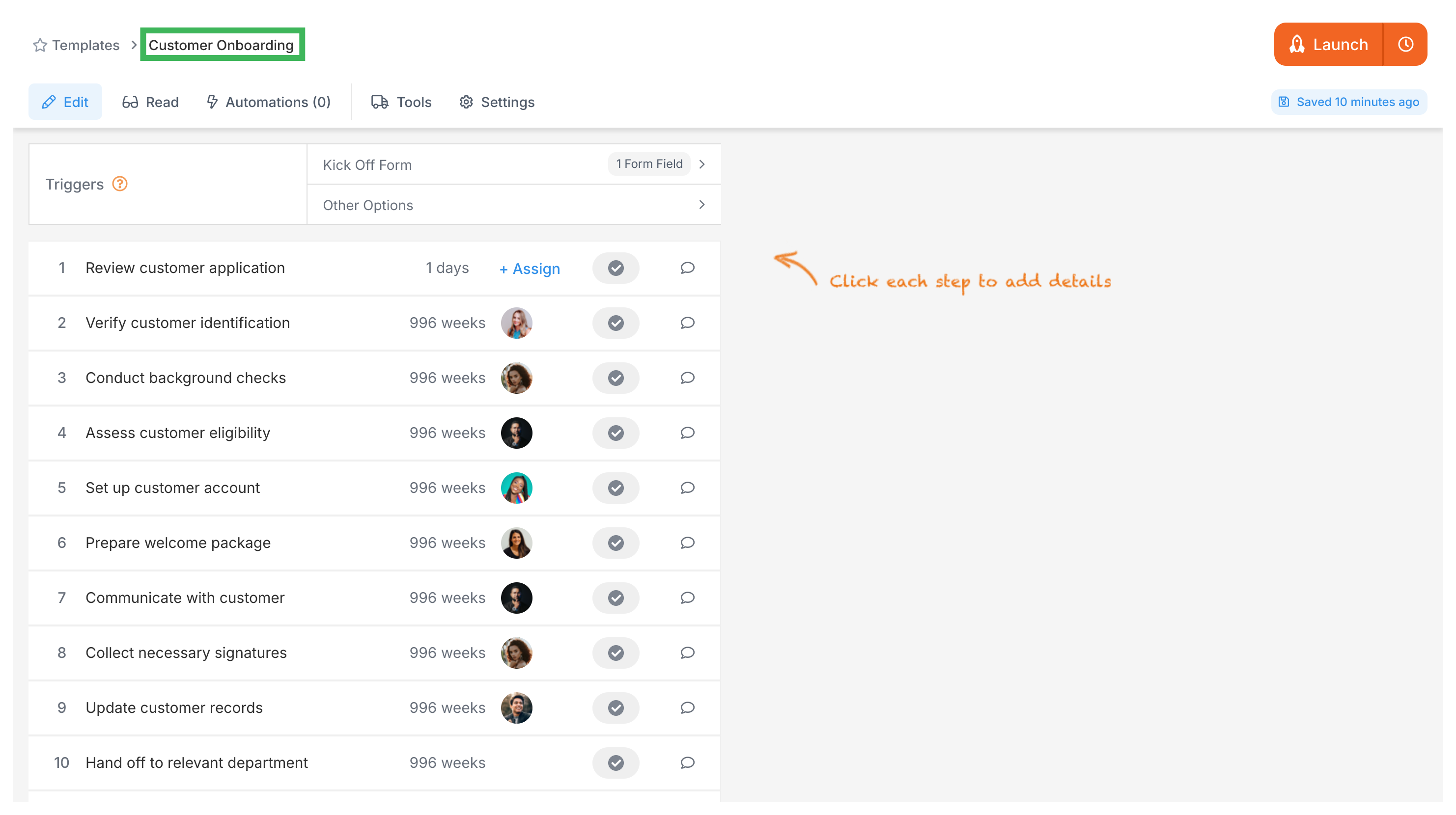
Modern BPM platforms focus on simplicity and usability rather than complex flowcharts.
Process mining tools
These specialized tools discover and analyze processes from system data.
Characteristics:
- Automatic process discovery
- Conformance checking
- Performance analysis
- Requires quality event data
RPA platforms
Robotic Process Automation tools automate repetitive tasks, often complementing broader BPM initiatives.
Characteristics:
- Task-level automation
- Works with existing systems
- Quick ROI for suitable processes
- Limited to structured tasks
Critical success factors for BPM
After analyzing hundreds of BPM implementations, certain patterns emerge that separate success from failure:
Start with culture, not technology
Organizations that succeed treat BPM as a business transformation, not an IT project. They invest in change management, communication, and training before buying software.
Focus on outcomes, not activities
Successful implementations measure business results (customer satisfaction, revenue, cost) not process metrics (tasks completed, workflows automated).
Embrace iteration over perfection
The best implementations launch quickly with "good enough" processes, then improve continuously based on real-world feedback.
Balance standardization with flexibility
Effective BPM standardizes the routine while accommodating exceptions. Over-standardization kills innovation; under-standardization creates chaos.
Maintain momentum through quick wins
Successful programs deliver value early and often. They don't wait for the perfect enterprise-wide implementation to show results.
Frequently asked questions about BPM
What's the difference between BPM and workflow automation?
BPM is the comprehensive discipline of managing and improving business processes - it includes strategy, methodology, and culture change. Workflow automation is one tool within BPM that uses technology to execute tasks automatically. Think of BPM as city planning and workflow automation as traffic lights - the lights help traffic flow, but they're just one part of the overall transportation strategy.
How much does BPM implementation typically cost?
Costs vary dramatically based on scope and approach. A department-level implementation using cloud tools might cost $10,000-50,000 annually. Enterprise-wide transformation with premium platforms can reach millions. However, modern SaaS solutions have democratized BPM - you can start with tools costing less than $100 per user monthly and scale as you prove value.
What's the difference between BPM and ERP?
ERP (Enterprise Resource Planning) systems manage core business data and transactions - finance, inventory, HR records. BPM manages how work flows through the organization using that data. ERP is your business database; BPM is how you orchestrate work around it. Many organizations use BPM to optimize processes that span multiple ERP modules or connect ERP with other systems.
Can small businesses benefit from BPM?
Absolutely. Small businesses often benefit more than large ones because they can implement changes faster and see results sooner. A 10-person company wasting 2 hours daily on inefficient processes loses 20% of its capacity. Modern cloud-based BPM tools make enterprise-grade capabilities affordable for any size organization.
How long before we see ROI from BPM?
Quick wins can appear within weeks - one company reduced invoice processing time by 50% in their first month. Full ROI typically comes within 6-18 months, depending on scope and complexity. The key is starting with high-impact, low-complexity processes to build momentum and fund expansion.
What skills does a BPM team need?
Successful BPM teams blend business and technical skills. You need people who understand process analysis, change management, and your specific business domain. Technical skills in process modeling, data analysis, and potentially system integration help, but business acumen matters more. Many organizations train existing staff rather than hiring specialists.
Should we use Six Sigma, Lean, or another methodology?
The best methodology depends on your specific challenges. Six Sigma excels at reducing variation in complex processes. Lean eliminates waste and improves flow. Agile BPM handles rapidly changing requirements. Most successful organizations combine elements from multiple methodologies rather than rigidly following one.
What's the biggest mistake organizations make with BPM?
Starting too big. Organizations attempt to transform everything simultaneously, overwhelming their change capacity and creating resistance. Successful BPM starts with one meaningful process, proves value, then expands. The second biggest mistake? Buying expensive technology before understanding their processes.
How does AI change BPM?
AI transforms BPM from reactive to predictive. Instead of discovering problems after they occur, AI predicts and prevents them. AI can route work intelligently, automate decisions, extract insights from unstructured data, and continuously optimize processes. However, AI enhances good processes - it won't fix fundamental process problems.
Can BPM work in creative or unpredictable industries?
Yes, but differently. Creative industries benefit from standardizing administrative processes (contracts, invoicing, project setup) while keeping creative work flexible. Even unpredictable work has predictable elements - emergency rooms can't predict what patients arrive, but they can optimize triage, resource allocation, and discharge processes.
Conclusion: The path forward
Business Process Management isn't just about efficiency - it's about building organizations that can adapt, scale, and thrive in constant change. The tools and methodologies have evolved dramatically, but the core principle remains: systematic improvement of how work gets done.
Success doesn't require massive investment or organizational transformation. It requires commitment to continuous improvement, willingness to challenge status quo, and discipline to measure and refine.
Start small. Pick one process that frustrates everyone. Map it, improve it, measure the results. Build from that success.
The organizations winning today aren't those with perfect processes - they're those constantly making their processes better. One percent improvement daily compounds into transformation.
Whether you choose traditional methodologies or modern platforms, remember that BPM is ultimately about people - helping them work smarter, not harder, and creating value for customers more effectively.
The journey from chaos to clarity starts with a single process. Which one will you improve first?